- You can access the menu by pressing the OK button.
- Use the Up and Down arrows to navigate through the menu and press the OK button to enter a submenu or change a setting.
- When editing a setting, the Up and Down buttons will let you scroll through the available options for that setting and the OK button will confirm your selection.
- Use the Back button to exit a setting.
This menu can be used to configure the internal IMU settings.
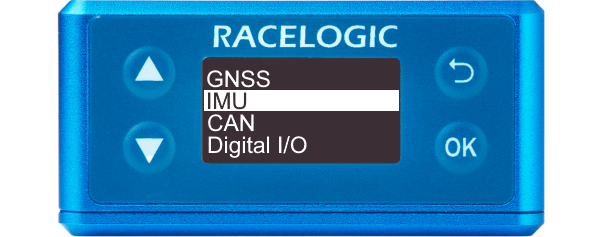
This menu can be used to configure the internal IMU settings.
This setting enables or disables Kalman Filter Wheel Speed Input.
If the unit cannot detect CAN data, you will see a status message on the front panel.
This action will add the Wheel Speeds channel to CAN ID 31D.
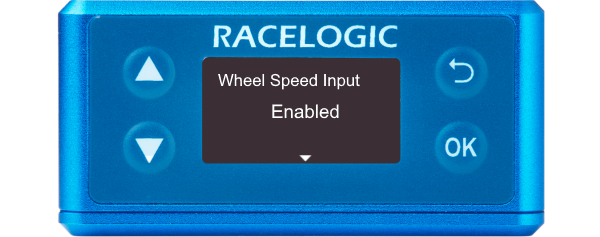
This setting enables or disables Kalman Filter Wheel Speed Input.
If the unit cannot detect CAN data, you will see a status message on the front panel.
This action will add the Wheel Speeds channel to CAN ID 31D.
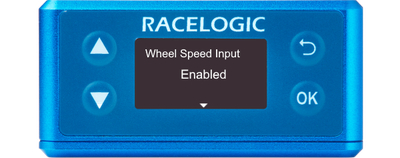
Note: If you need to configure the wheel speed signal format, you can do this in VBOX Setup software.
This setting specifies the X, Y, and Z distances between the antenna and the wheel speed reference point.
The reference point is the centre point between the rear wheels.
You can find more information here.
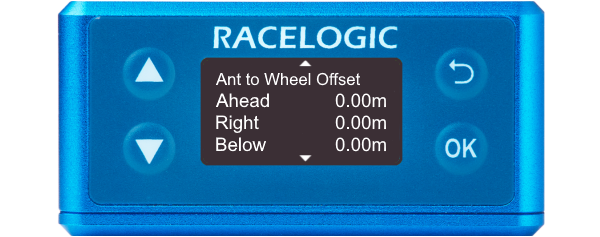
This setting specifies the X, Y, and Z distances between the antenna and the wheel speed reference point.
The reference point is the centre point between the rear wheels.
You can find more information here.
Note: This option is only presented when Wheel Speed Input is Enabled.
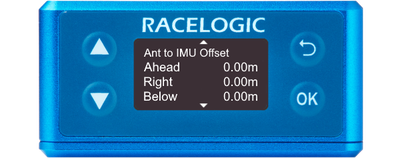
Provides the X, Y, and Z offset values from the antenna to VBOX Omega that is required for the Kalman Filter algorithm.
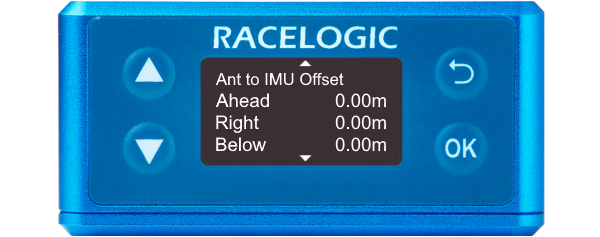
Provides the X, Y, and Z offset values from the antenna to VBOX Omega that is required for the Kalman Filter algorithm.
This is where you can add the X, Y, and Z offset values from the IMU to the nominated reference point where all measurements will be made.
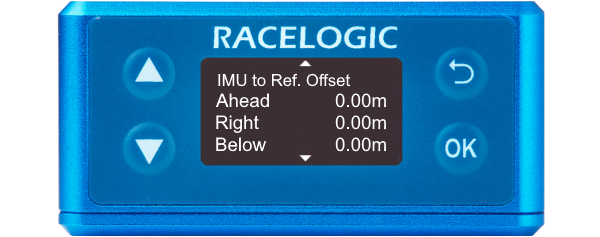
This is where you can add the X, Y, and Z offset values from the IMU to the nominated reference point where all measurements will be made.
Select the orientation of the side of VBOX Omega facing down. This is only applied once the IMU menu is exited to the Main Menu. When the orientation is changed, the Kalman Filter is reset.
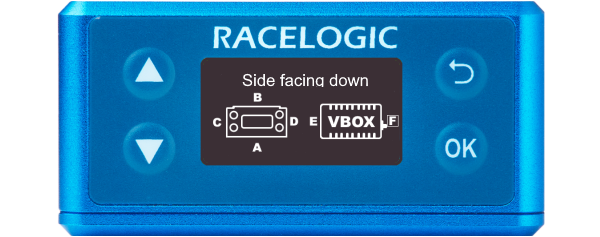
Select the orientation of the side of VBOX Omega facing down. This is only applied once the IMU menu is exited to the Main Menu. When the orientation is changed, the Kalman Filter is reset.
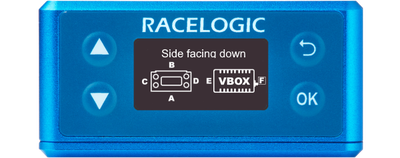
Note: If you use an invalid combination of sides facing down/forward, you will see an error message when you exit the IMU menu.
Select the orientation of the side of VBOX Omega facing forward. This is only applied once the IMU menu is exited to the Main Menu. When the orientation is changed, the Kalman Filter is reset.
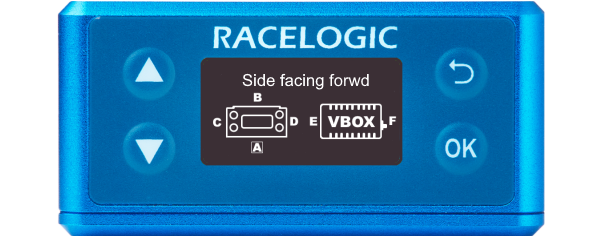
Select the orientation of the side of VBOX Omega facing forward. This is only applied once the IMU menu is exited to the Main Menu. When the orientation is changed, the Kalman Filter is reset.
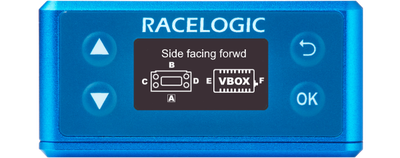
Note: If you use an invalid combination of sides facing down/forward, you will see an error message when you exit the IMU menu.
Auto Level
Begins the process of levelling the IMU calculated Pitch and Roll Angles. Once selected, the unit averages the pitch/roll angles over a 5-second period and will then subtract/add the averaged values to make the pitch/roll angle 0. This offset will be displayed on the main screen.
Clear
Clears the current pitch/roll offset values.
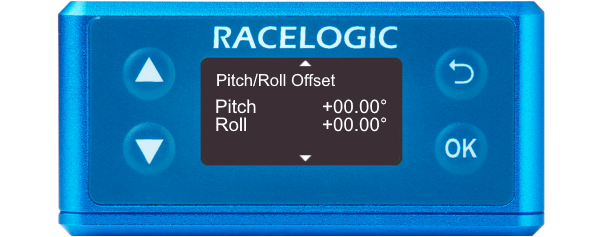
Auto Level
Begins the process of levelling the IMU calculated Pitch and Roll Angles. Once selected, the unit averages the pitch/roll angles over a 5-second period and will then subtract/add the averaged values to make the pitch/roll angle 0. This offset will be displayed on the main screen.
Clear
Clears the current pitch/roll offset values.
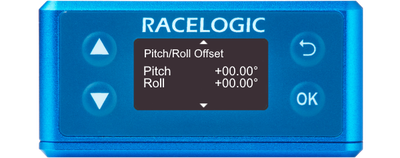
Note: The Kalman Filter must be initialised for this function to be completed and offsets are reset to 0 at each power cycle.
Auto Level
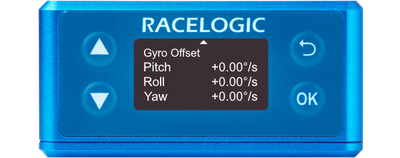
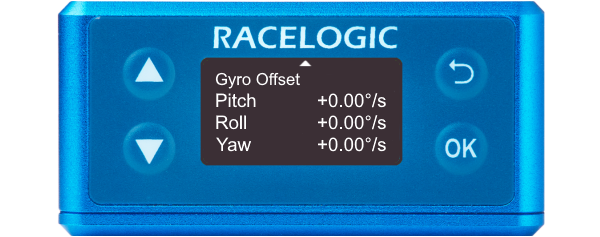
Begins the process of levelling the IMU calculated Pitch, Roll and Yaw Rates. Once selected, the unit averages the rates over a 5-second period and will then subtract/add the averaged values to make the rates equal to 0. These offsets will be displayed on the main screen.
Clear
Clears the current offset values.
Auto Level
Begins the process of levelling the IMU calculated Pitch, Roll and Yaw Rates. Once selected, the unit averages the rates over a 5-second period and will then subtract/add the averaged values to make the rates equal to 0. These offsets will be displayed on the main screen.
Clear
Clears the current offset values.