
Click on the IMU version you are using to see the relevant IMU integration instructions.
Required Equipment
- VBOX 3i ADAS
- IMU04
- RLCAB119 – VBOX - IMU connecting cable
- RLCAB001 / RLCAB066-2 - VBOX 3i PC connection cable
- VBOX Setup Software
- RLCAB069L / RLCAB015L / RLACS182L - vehicle CAN bus cable (optional for wheel speeds)
Setup
Hardware
IMPORTANT
The IMU04 must be connected to the VBOX 3i ADAS before you apply power to make the data synchronise correctly.
- Install the VBOX 3i ADAS in the test vehicle, and mount the IMU as described in the IMU04 User Guide.
- Fit the VBOX 3i ADAS GNSS antenna to the centre of the vehicle's roof. Connect the antenna to the VBOX 3i ADAS unit.
- If you are mounting the antenna on the roof, you must measure the relative position from the top centre of the GNSS antenna* to the top centre of the IMU. You need to make these measurements in all 3 axes, X, Y and Z.
NOTE
When using a twin antenna system, you must start these measurements at the main antenna (A).
- IMU04 – Connect the CAN/KF port to the VBOX 3i ADAS 25 W D analogue input port with the RLCAB119 cable.
- When you have connected the IMU, you can apply power to the VBOX 3i ADAS.
- Enable IMU integration with the VBOX Setup software.
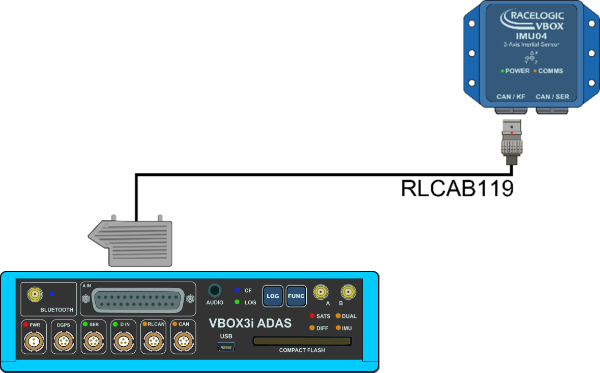
Configuration in VBOX Setup Software
- Make sure that the IMU04 is connected via RLCAB119, and that the VBOX 3i ADAS is powered on.
- Connect the VBOX 3i ADAS to the PC using an RLCAB001 or RLCAB066-2 cable (RS232 or USB).
- Open VBOX Setup and connect to the VBOX 3i ADAS by selecting the relevant COM Port.
- Open the Logging menu and make sure that the Log rate is set to 100 Hz.
- Open the IMU menu and tick Enable IMU integration.
- If your antenna is mounted on the roof, you must also tick Enable roof mount.
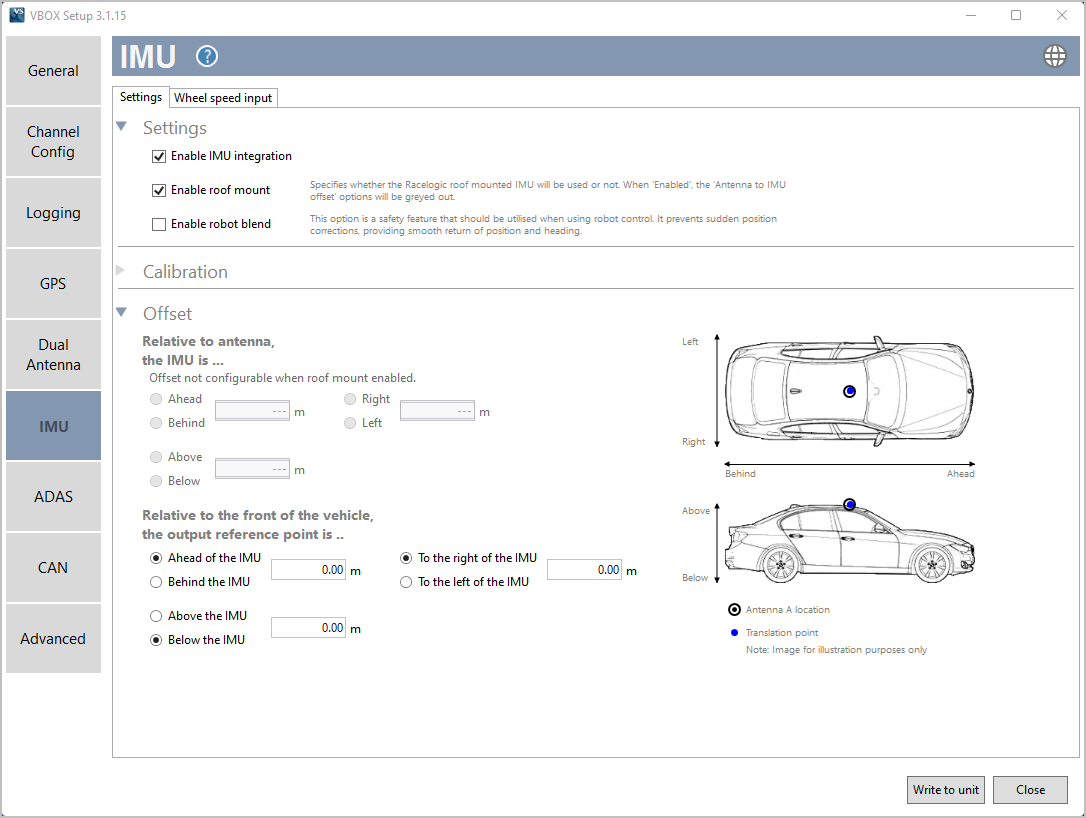
- If you are not using a roof-mounted antenna, you must enter the distances measured between the IMU and antenna A. You can find more information on this here.
- If you would like to translate the data from the IMU location to another point on the vehicle where all measurements will be made, enter the x, y, z offset values from the required translation point to the IMU.
- The IMU Attitude channels (Head_imu, Pitch_imu, Roll_imu, Pos.Qual., Lng_Jerk, Lat_Jerk and Head_imu2) will be set to log automatically.
- The Serial IMU channels (x accel, y accel, z accel, temp, pitch rate, roll rate and yaw rate) will also be set to log automatically .
NOTES
- If you want to view the CAN data live, you must have a multi-functional display (e.g. MFD Touch) connected and tick the Send to MFD box for the channel.
- If you want to display the IMU Attitude data as a Live Serial data display and you are using an alternative software to VBOX Test Suite, you must tick the Advanced box in the top right corner and tick the channels for Send over serial.

- Click Write to unit to upload the settings to the VBOX 3i ADAS.
- You must perform an initialisation and full calibration procedure before you start testing.
IMPORTANT
- You cannot use the IMU04 for IMU integration if it is connected to the VBOX 3i ADAS via CAN (RLCAB120 / RLCAB005-CS). This method of connection will only allow you to log standard IMU channels. See using IMU as CAN module section for details.
- The IMU04 standard channels can also be logged when the IMU04 is connected via the KF port with cable RLCAB119, without enabling IMU integration.
- The IMU04 must be in a Racelogic CAN mode to be used for IMU Kalman Filter.
NOTE
The GNSS antenna and IMU should be co-located (roof mount) or positioned so there is no relative X or Y offset between them. If there is a difference, manual contact points should reference the IMU location, rather than the GNSS antenna.
Vehicle speed data can be combined with inertial IMU data to provide increased data accuracy in environments that have poor satellite reception, such as areas with trees, buildings, bridges or tunnels. You can find more information on this here.
To obtain the wheel speed information, the best method is to use the sensors that are already fitted to the vehicle by connecting to the vehicle’s CAN bus with an RLCAB069L, RLCAB015L or RLACS182L cable. Before you start testing, you must make sure that the VBOX 3i ADAS unit is correctly connected to either the speed sensors or to the vehicle CAN bus.
Next, you need to enable and configure the wheel speed input in the VBOX Setup software.
- Make sure that the IMU04 is connected via RLCAB119, and that the VBOX 3i is powered on.
- Connect your VBOX 3i to a computer, either via Bluetooth (an RLCAB001 cable to the SER input and the computer's serial port, you may need a usb-serial adapter), or via an RLCAB066-2 cable to one of the computer's USB ports.
- Open VBOX Setup and connect to VBOX 3i by selecting the relevant COM Port.
- Open the IMU menu and select the Wheel speed input tab.
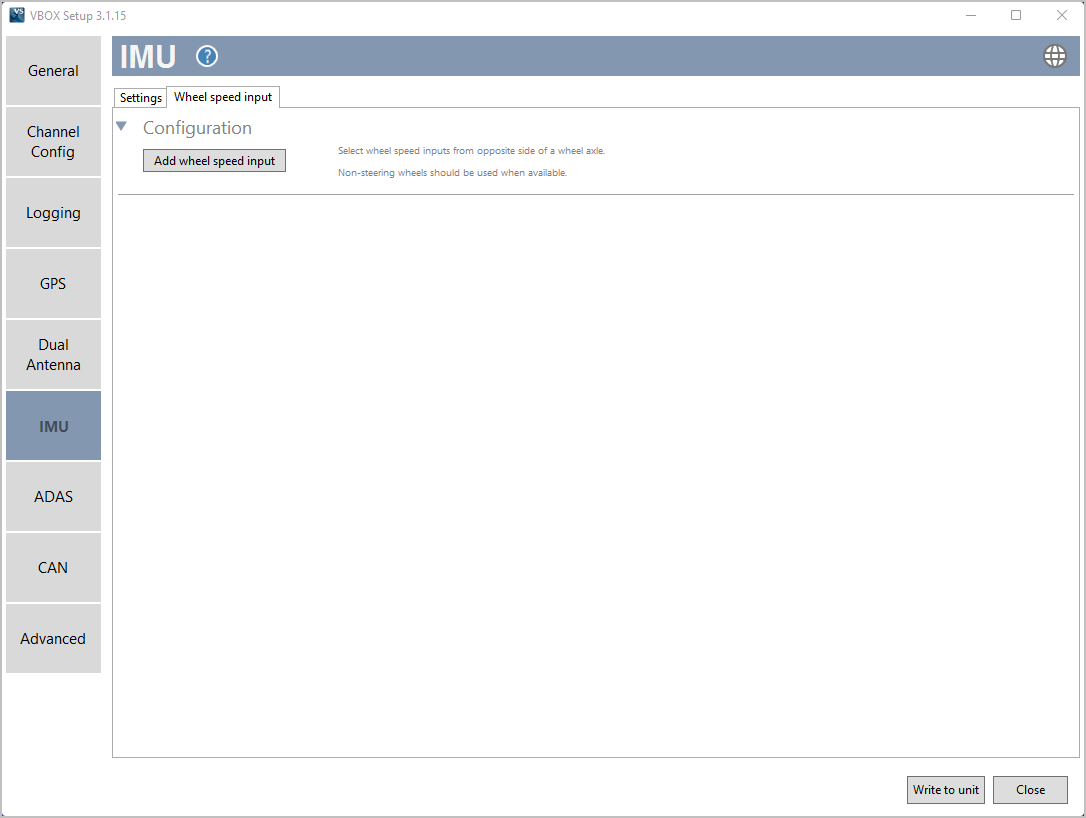
- Click the Add wheel speed input to start configuring the inputs.
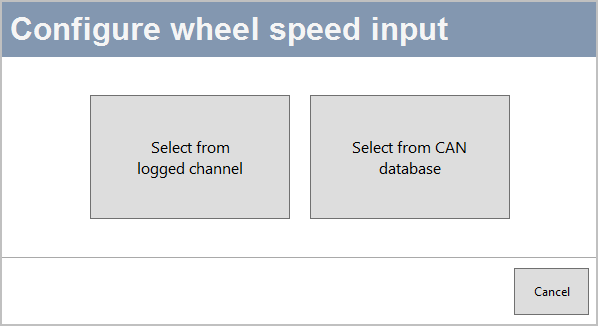
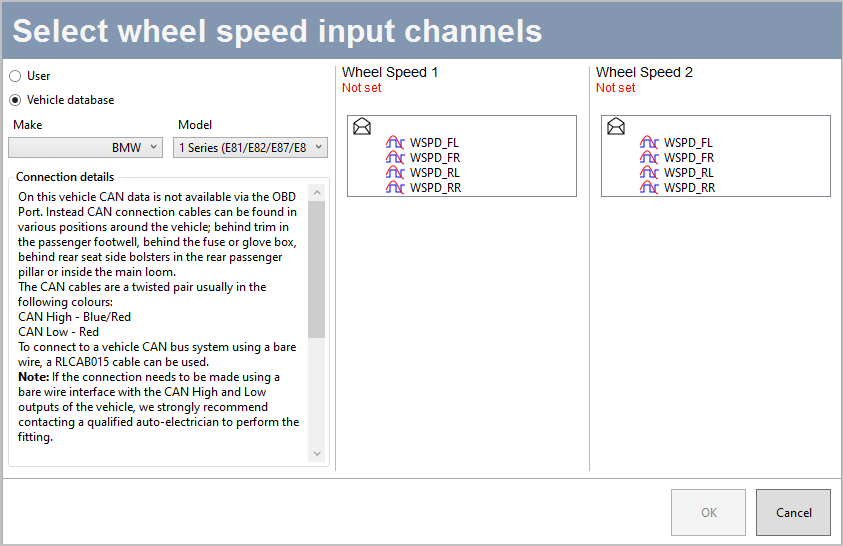
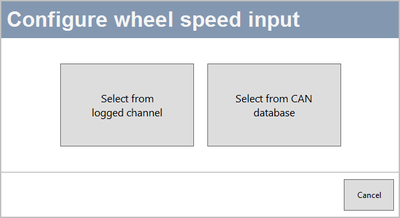
- Configure the inputs by selecting the applicable input for each wheel speed.
- Click OK
- Select Write to unit to save the settings.
Initialisation
When you are using IMU integration, you need to run an initialisation phase after you connect the IMU to the VBOX. This will automatically start when the VBOX has successfully gained satellite lock. When the initialisation sequence has started the IMU LED will go solid green once movement is detected.
| IMU04 LED Colour | Power | Coms |
|---|---|---|
Red |
Initial boot up phase. |
No coms. |
Orange |
Temperature checks. If temperature outside optimum operation range, LED will remain orange. |
Using IMU integration, inertial data being sent to host VBOX via RS232. |
Green |
Fully operational. |
Inertial data being sent to host system via CAN. |
You can find information about the LEDs on the VBOX 3i ADAS here.
Required Equipment
- VBOX 3i ADAS unit
- GNSS antenna(s)
- Power cable/battery pack
- IMU05 unit
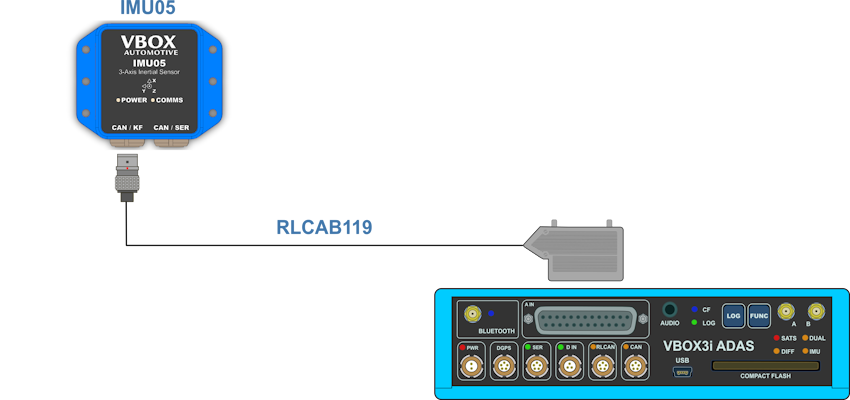
- RLCAB119 – VBOX - IMU connecting cable
- RLCAB001 / RLCAB066-2 - VBOX 3i PC connection cable
- VBOX Setup Software
- RLCAB069L / RLCAB015L / RLACS182L - vehicle CAN bus cable (optional for wheel speeds)
Setup
Hardware
IMPORTANT
The IMU05 must be connected to the VBOX 3i ADAS before you apply power to make the data synchronise correctly.
- Install the VBOX 3i ADAS in the test vehicle, and mount the IMU as described in the IMU05 User Guide.
- Fit the VBOX 3i ADAS GNSS antenna to the centre of the vehicle's roof. Connect the antenna to the VBOX 3i ADAS unit.
- If you are mounting the antenna on the roof, you must measure the relative position from the top centre of the GNSS antenna* to the top centre of the IMU. You need to make these measurements in all 3 axes, X, Y and Z.
NOTE
When using a twin antenna system, you must start these measurements at the main antenna (A).
- IMU05 – Connect the CAN/KF port to the VBOX 3i ADAS 25 W D analogue input port with the RLCAB119 cable.
- When you have connected the IMU, you can apply power to the VBOX 3i ADAS.
- Enable IMU integration with the VBOX Setup software.
Configuration in VBOX Setup Software
- Make sure that the IMU05 is connected via RLCAB119, and that the VBOX 3i ADAS is powered on.
- Connect the VBOX 3i ADAS to the PC using an RLCAB001 or RLCAB066-2 cable (RS232 or USB).
- Open VBOX Setup and connect to the VBOX 3i ADAS by selecting the relevant COM Port.
- Open the Logging menu and make sure that the Log rate is set to 100 Hz.
- Open the IMU menu and tick Enable IMU integration.
- If your antenna is mounted on the roof, you must also tick Enable roof mount.
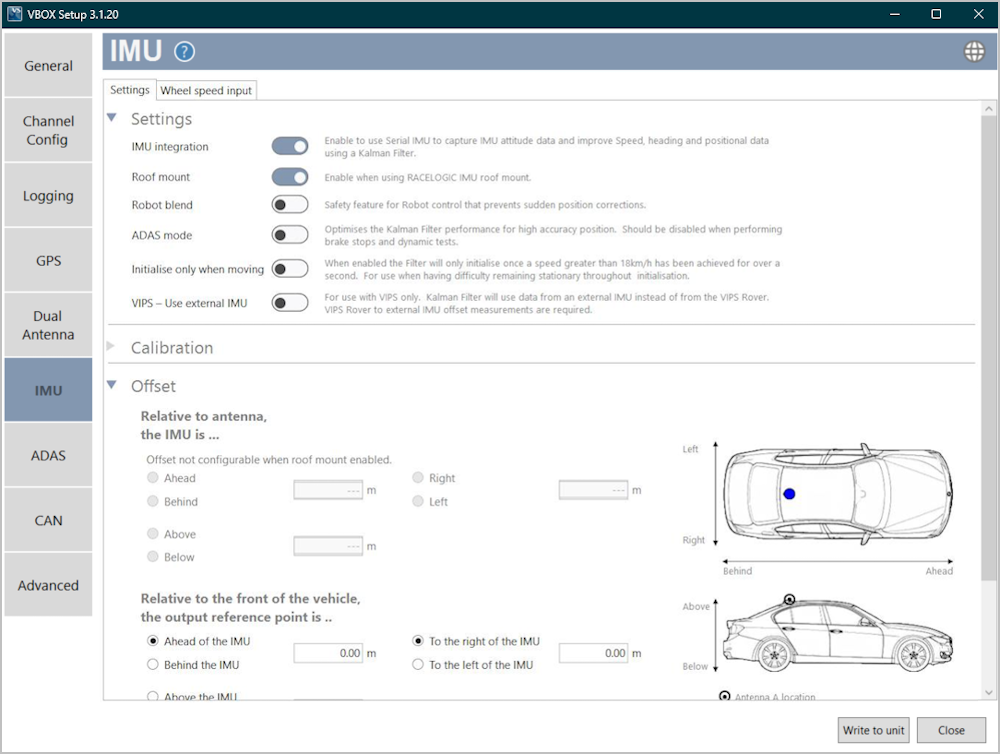
- If you are not using a roof-mounted antenna, you must enter the distances measured between the IMU and antenna A. You can find more information on this here.
- If you would like to translate the data from the IMU location to another point on the vehicle where all measurements will be made, enter the x, y, and z offset values from the required translation point to the IMU, more information on this can be found here.
- The IMU Attitude channels (Head_imu, Pitch_imu, Roll_imu, Pos.Qual., Lng_Jerk, Lat_Jerk and Head_imu2) will be set to log automatically.
- The Serial IMU channels (x accel, y accel, z accel, temp, pitch rate, roll rate and yaw rate) will also be set to log automatically.
NOTES
- If you want to view the CAN data live, you must have a multi-functional display (e.g. MFD Touch) connected and tick the Send to MFD box for the channel.
- If you want to display the IMU Attitude data as a Live Serial data display and you are using an alternative software to VBOX Test Suite, you must tick the Advanced box in the top right corner and tick the Send over serial box for the relevant channels.
- Click on the Write to unit button to upload the new configurations to the VBOX 3i ADAS unit.
- Perform the Kalman Filter Calibration.
- Perform the IMU Calibration process in the IMU menu in VBOX Setup.
IMPORTANT
- You cannot use the IMU05 for IMU integration if it is connected to the VBOX 3i ADAS via CAN (RLCAB120 / RLCAB005-CS). This method of connection will only allow you to log standard IMU channels. See using IMU as CAN module section for details.
- The IMU05 standard channels can also be logged when the IMU05 is connected via the KF port with cable RLCAB119, without enabling IMU integration.
- The IMU05 must be in a Racelogic CAN mode to be used for IMU Kalman Filter.
- The GNSS antenna and IMU should be co-located (roof mount) or positioned so there is no relative X or Y offset between them. If there is a difference, manual contact points should reference the IMU location, rather than the GNSS antenna.
Wheel Speed Inputs
Vehicle speed data can be combined with inertial IMU data to provide increased data accuracy in environments that have poor satellite reception, such as areas with trees, buildings, bridges or tunnels. You can find more information on this here.
To obtain the wheel speed information, the best method is to use the sensors that are already fitted to the vehicle by connecting to the vehicle’s CAN bus with an RLCAB069L, RLCAB015L or RLACS182L cable. Before you start testing, you must make sure that the VBOX 3i ADAS unit is correctly connected to either the speed sensors or to the vehicle CAN bus.
Next, you need to enable and configure the wheel speed input in the VBOX Setup software.
- Make sure that the IMU05 is connected via RLCAB119, and that the VBOX 3i ADAS is powered on.
- Connect your VBOX 3i ADAS to a computer, either via Bluetooth (an RLCAB001 cable to the SER input and the computer's serial port, you may need a USB-serial adapter), or via an RLCAB066-2 cable to one of the computer's USB ports.
- Open VBOX Setup and connect to VBOX 3i ADAS by selecting the relevant COM Port.
- Open the IMU menu and select the Wheel speed input tab.
- Click the Add wheel speed input to start configuring the inputs.
- Configure the inputs by selecting the applicable input for each wheel speed.
- Click OK
- Select Write to unit to save the settings.
Initialisation
When you are using IMU integration, you need to run an initialisation phase after you connect the IMU to the VBOX. This will automatically start when the VBOX has successfully gained satellite lock. When the initialisation sequence has started the IMU LED will go solid green once movement is detected.
| IMU05 LED Colour | Power | Coms |
|---|---|---|
Red |
Initial boot up phase. | No coms. |
Orange |
Temperature checks. If temperature outside optimum operation range, LED will remain orange. | Using IMU integration, inertial data being sent to host VBOX via RS232. |
Green |
Fully operational. | Inertial data being sent to host system via CAN. |
You can find information about the LEDs on the VBOX 3i ADAS here.
Required Equipment
- VBOX 3i ADAS unit
- GNSS antenna(s)
- Power cable/battery pack
- IMU05-S unit
- RLCAB119 – VBOX - IMU connecting cable
- RLCAB001 / RLCAB066-2 - VBOX 3i PC connection cable
- VBOX Setup Software
- RLCAB069L / RLCAB015L / RLACS182L - vehicle CAN bus cable (optional for wheel speeds)
IMPORTANT
The IMU05-S must be connected to the VBOX 3i ADAS before you apply power to make the data synchronise correctly.
Setup
Hardware
- Install the VBOX 3i ADAS in the test vehicle, and mount the IMU as described here.
- Fit the VBOX 3i ADAS GNSS antenna to the centre of the vehicle's roof. Connect the antenna to the VBOX 3i ADAS unit.
- If you are mounting the antenna on the roof, you must measure the relative position from the top centre of the GNSS antenna to the top centre of the IMU. You need to make these measurements in all 3 axes, X, Y and Z.
NOTE
When using a twin antenna system, you must start these measurements at the main antenna (A).
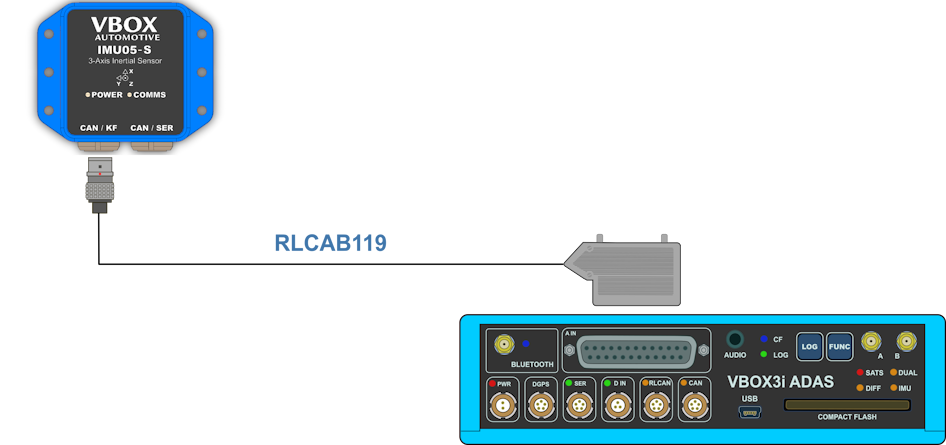
- IMU05-S – Connect the CAN/KF port to the VBOX 3i ADAS 25 W D analogue input port with the RLCAB119 cable.
- When you have connected the IMU, you can apply power to the VBOX 3i ADAS.
- Enable IMU integration with the VBOX Setup software.
Configuration in VBOX Setup Software
- Make sure that the IMU05-S is connected via RLCAB119, and that the VBOX 3i ADAS is powered on.
- Connect the VBOX 3i ADAS to the PC using an RLCAB001 or RLCAB066-2 cable (RS232 or USB).
- Open VBOX Setup and connect to the VBOX 3i ADAS by selecting the relevant COM Port.
- Open the Logging menu and make sure that the Log rate is set to 100 Hz.
- Open the IMU menu and tick Enable IMU integration.
- If your antenna is mounted on the roof, you must also tick Enable roof mount.
- If you are not using a roof-mounted antenna, you must enter the distances measured between the IMU and antenna A. You can find more information on this here.
- If you would like to translate the data from the IMU location to another point on the vehicle where all measurements will be made, enter the x, y, and z offset values from the required translation point to the IMU, more information on this can be found here.
- The IMU Attitude channels (Head_imu, Pitch_imu, Roll_imu, Pos.Qual., Lng_Jerk, Lat_Jerk and Head_imu2) will be set to log automatically.
- The Serial IMU channels (x accel, y accel, z accel, temp, pitch rate, roll rate and yaw rate) will also be set to log automatically.
NOTES
- If you want to view the CAN data live, you must have a multi-functional display (e.g. MFD Touch) connected and tick the Send to MFD box for the channel.
- If you want to display the IMU Attitude data as a Live Serial data display and you are using an alternative software to VBOX Test Suite, you must tick the Advanced box in the top right corner and tick the Send over serial box for the relevant channels.
- Click on the Write to unit button to upload the new configurations to the VBOX 3i ADAS unit.
- Perform the Kalman Filter Calibration.
- Perform the IMU Calibration process in the IMU menu in VBOX Setup.
IMPORTANT
- You cannot use the IMU05-S for IMU integration if it is connected to the VBOX 3i ADAS via CAN (RLCAB120 / RLCAB005-CS). This method of connection will only allow you to log standard IMU channels. See using IMU as CAN module section for details.
- The IMU05-S standard channels can also be logged when the IMU05-S is connected via the KF port with cable RLCAB119, without enabling IMU integration.
- The IMU05-S must be in a Racelogic CAN mode to be used for IMU Kalman Filter.
- The GNSS antenna and IMU should be co-located (roof mount) or positioned so there is no relative X or Y offset between them. If there is a difference, manual contact points should reference the IMU location, rather than the GNSS antenna.
Wheel Speed Inputs
Vehicle speed data can be combined with inertial IMU data to provide increased data accuracy in environments that have poor satellite reception, such as areas with trees, buildings, bridges or tunnels. You can find more information on this here.
To obtain the wheel speed information, the best method is to use the sensors that are already fitted to the vehicle by connecting to the vehicle’s CAN bus with an RLCAB069L, RLCAB015L or RLACS182L cable. Before you start testing, you must make sure that the VBOX 3i ADAS unit is correctly connected to either the speed sensors or to the vehicle CAN bus.
Next, you need to enable and configure the wheel speed input in the VBOX Setup software.
- Make sure that the IMU05-S is connected via RLCAB119, and that the VBOX 3i is powered on.
- Connect your VBOX 3i to a computer, either via Bluetooth (an RLCAB001 cable to the SER input and the computer's serial port, you may need a usb-serial adapter), or via an RLCAB066-2 cable to one of the computer's USB ports.
- Open VBOX Setup and connect to VBOX 3i by selecting the relevant COM Port.
- Open the IMU menu and select the Wheel speed input tab.
- Click the Add wheel speed input to start configuring the inputs.
- Configure the inputs by selecting the applicable input for each wheel speed.
- Click OK
- Select Write to unit to save the settings.
Initialisation
When you are using IMU integration, you need to run an initialisation phase after you connect the IMU to the VBOX. This will automatically start when the VBOX has successfully gained satellite lock. When the initialisation sequence has started the IMU LED will go solid green once movement is detected.
| IMU05-S LED Colour | Power | Coms |
|---|---|---|
Red |
Initial boot up phase. | No coms. |
Orange |
Temperature checks. If temperature outside optimum operation range, LED will remain orange. | Using IMU integration, inertial data being sent to host VBOX via RS232. |
Green |
Fully operational. | Inertial data being sent to host system via CAN. |
You can find information about the LEDs on the VBOX 3i ADAS here.