This article shows how to convert the data from a Mini/Micro input module into a more meaningful format, for example converting a voltage from a throttle or brake pedal into something more useful like a throttle pedal percentage 0-100%.
It should be noted that this calculation only works for linear data where the plot of the data produces a straight line.
For those who don't like maths - please use our 'Scale and Offset Calculator'.
For example, say the throttle position sensor gives 0.5 volts on closed throttle, and 5 volts at full throttle.
To convert this into a percentage, the equation of the straight line needs to be calculated.
The equation describing a straight line is as follows:
Y = mX + c
Where;
| Y = The Y Values | (% pedal press) |
| X = The X Values | (Sensor voltage) |
| m = scale | (Gradient of line) |
| c = offset | (Intercept with the Y-axis) |
For example, say the throttle position sensor gives 0.5 volts on closed throttle, and 5 volts at full throttle.
To convert this into a percentage, the equation of the straight line needs to be calculated.
The equation describing a straight line is as follows:
Y = mX + c
Where;
| Y = The Y Values | (% pedal press) |
| X = The X Values | (Sensor voltage) |
| m = scale | (Gradient of line) |
| c = offset | (Intercept with the Y-axis) |
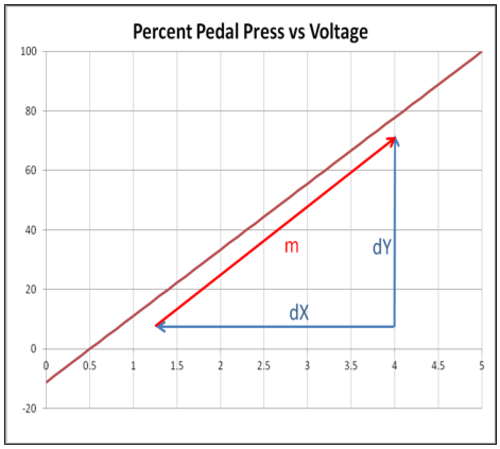
The gradient of a line is the change in Y divided by the change in X which gives:
| m (gradient) = dY/dX | (change in Y) / (change in X) |
| dY = 100 - 0 = 100 | change in Y = 100% - 0% = 100 |
| dX = 5 = 0.5 = 4.5 | change in X = 5 volts - 0.5 volts = 4.5 |
Therefore the gradient of the line is:
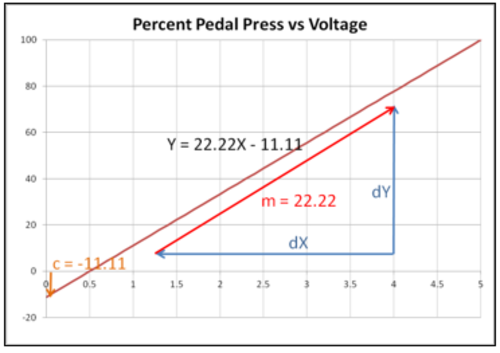
dY/dX = 100 / 4.5 = 22.22
The Scale is 22.22.
To find the offset value, substitute the known values at zero throttle, back into the equation:
Y = percent = 0, X = Voltage = 0.5 V
| Y = mX + C | Therefore |
| 0 = (22.22 * 0.5) + c | Zero throttle % = gradient x 0.5 volts + Offset |
| 0 = 11.11 + c | |
| C = -11.11 | The Offset is -11.11 |
Substituting these values back into the equation again gives us the full equation of the line which passes through our two points.
Y = 22.22X – 11.11
We can double check our equation is correct by calculating a percentage value for a known voltage output.
We know that:
| Voltage (x) | Percent Pedal Press (y) |
|---|---|
| 0.5 | 0 |
| 5 | 100 |
Using the equation we have just derived produces the following results:
| Y = 22.22X – 11.11 | |
Y = (22.22 * 0.5) – 11.11 = 0% | This is correct, as 0.5 volts is equal to a 0% pedal press. |
Y = (22.22 * 5.0) – 11.11 = 99.99% | This is also correct as we know that 5 volts = 100% pedal press. |
The graph below illustrates the calculated scale and offset values.